A Christmas Gift For You

December 16th, 2010

On the first day of Christmas, my true love gave to me…
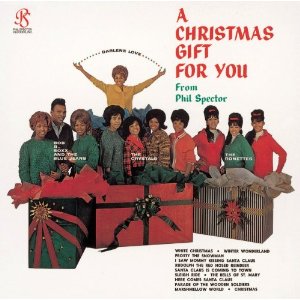

Artist: Various Artists
Title:  A Christmas Gift For You from Phil Spector
Label: Philles
Released: 1963, various re-issues over the past 45 plus years
Genre: 60’s Rock, Girl Groups

I can’t remember what year I was, but I was in high school when I purchased this album. It was at least sixteen years after its original release. I was in pursuit of my own Christmas sound.

I know I already had purchased a Springsteen bootleg with ”Santa Claus Is Coming To Town” on it, but that was just one song. I had also bought the Motown Christmas album, but I found it spotty. I didn’t have enough Christmas music in my collection to make a mix tape at the time either. I didn’t have a complete holiday soundtrack.

The only other Christmas music I had access to was my mother’s three Christmas LPs; Christmas Music on the Pipe Organ with Chimes, a budget Christmas LP called Rudolph the Red-Nosed Reindeer on the Diplomat label, and the Bob Ralston Christmas Album, a collection of medleys by an adult chorus accompanied by Mr. Ralston on organ. This was music of a bridge club.

There it was, for $2.99 in the used record bin at Hot Licks (a local indie record store), A Christmas Gift For You. Damn right it was.

Three ascending solo piano notes open the album, and then the signature Wall of Sound hits you. Brass carries the bass line with the piano rolling underneath, sleigh bells jingle, glockenspiels chime and hand claps! Yes, hand claps, the most basic form of percussion and an identifying sound of 60s pop! And then there’s Darlene Love, yearning for her very own “White Christmas,” just like me.

The next track, drummer Hal Blaine brings “Frosty the Snowman” to life more than the magic hat. The short sustain of the pizzicato are landmarks in Frosty’s journey throughout the town as the strings lay a pathway.

Bob B. Soxx & The Blue Jeans take of “The Bells of St. Mary’s” rivals the Drifters’ version. The Crystals’ “Santa Claus Is Coming To Town” was the version for which Springsteen based his cover. The manic Leroy Anderson composed “Sleigh Ride” swings in comparison to its many previous undertakings. “I Saw Mommy Kissing Santa Claus” incorporates the bossa-beat, which was the craze back in 1963.

The sound is just so big. It’s as big as the spectacle of commercial Christmas. During the holidays we’re bombarded by lights, displays, sales, cards, hustle and bustle.  In the songs too we are exposed to the Wall of sound, but the strings and the voices caress, the rhythm section makes us want to dance an the bells and chimes accent the holiday spirit. It is brilliance in musical arrangement.

Amongst the thirteen songs, twelve are recognizable standards, now all dolled up in Spector fashion. But the one track that makes the statement is the Spector-Greenwich-Barry original, “Christmas (Baby Please Come Home).” It’s the first holiday song I play every year and the one I listen to over and over every holiday season for the past thirty-some odd years.  Once again, it’s Darlene Love yearning. She’s missing her boyfriend as she watches the snow come down, hears church bells and carolers as she watches the pretty lights on the tree shine. “They’re singing ‘Deck The Halls’ / But it’s not like Christmas at all,” sings Ms. Love. She’s missing that one last element for a merry Christmas, her boyfriend. “If there was a way / I’d hold back this tear / But it’s Christmas day / Baby please come home.” Wow!

There are no elements missing in this holiday collection. Even Phil Spector’s corny formal exposition over “Silent Night” can’t mar this work. If there’s one Christmas album to own, this is it.
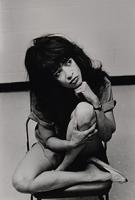
Ronnie Spector, Say Goodbye To Hollywood

September 29th, 2010

Artist: Ronnie Spector & The E-Street Band
Album: 12” Promo Single of “Say Goodbye To Hollywood”
Label: Epic / Cleveland International
Released: 1977
Genre: Rock
Purchased: Charlie’s 33s and CDs, Albuquerque, New Mexico, March 2010
Price: $17.99
Condition: Excellent

My first Spector record I found was called Echoes of the 60s. This was a collection of Phil’s work. I was steered to it through reading articles about Springsteen’s Born To Run. It was a collection of various singles by Bob B. Soxx & the Blue Jeans, the Crystals, Checkmates Ltd., Darlene Love, and of course, Veronica Spector, nee Bennett, and the Ronettes. The album contained the Ronettes’ “Be My Baby,” “Walking In The Rain,” and “Baby I Love You.”

Among all the pieces of rock candy on the album, Ronnie Spector’s had the most allure to a 16-year-old kid, born one generation too late.  This led to the purchase of a Ronettes’ Greatest Hits LP and then later a two-LP Phil Spector retrospective.

At the same time my interest in Springsteen grew. I had completed the collection of the first four Springsteen albums available at the time, but it did not satisfy my appetite. My musical vocabulary expanded with the discovery of the word bootleg. A bootleg, I learned was generally a live recording, usually of inferior quality, and illegal. These pressings were not distributed by the artists’ label and the artist did not profit from its sales. This was the music underground and I wanted in.

One of the Springsteen boots I bought was called The Great White Boss, a live recording from the Bottom Line in NYC from 1975 with a couple of bonus tracks. On the album he covered the Crystals’ “Then (S)He Kissed Me,” it was a direct connection to Phil Spector. The last track on the album was a bonus cut, recorded in a studio in 1973. A song Springsteen penned, “You Mean So Much To Me.”

I learned from a fellow Springsteen fan that Southside Johnny covered it on his I Don’t Wanna Go Home album. It was a duet with Ronnie Spector.

I almost shit in my pants.

He also informed me of this song she recorded with the E-Street band called, “Say Goodbye To Hollywood.”

I changed my pants.

He explained to me that it was a promo only release, which meant I couldn’t just go to my local independent record store and order up a copy. A promotional copy is not intended for public sale. It is put out there to taunt us and make us feel inferior to those in the record business. I hoped that maybe I’d find it on a bootleg. It had to be the most amazing song ever recorded.

There probably hasn’t been a full week in my life between 1979 and the present where I have not been in some sort of music retailer. I searched hard and heavy for that single until about 1984. That’s when, in my eyes, the man who led me to the music underground, Bruce Springsteen sold out with his Born In The USA record. He put his ass on the cover, married a model and had top 40 hits. He might as well been Billy Joel. I can’t stand Billy Joel.

So over thirty years later, I’m in Albuquerque, New Mexico at an indie store called Charley’s and I find a promo 12” of “Say Goodbye To Hollywood” by Ronnie Spector and the E-Street Band. It’s eighteen-freakin’-bucks. I haven’t seen one in thirty years. I’ve lost the passion for it but I still feel that I shouldn’t pass it up. I slap down the plastic and acquire it.

A few days later, I’m back home in St. Paul, unpacking, looking at the vinyl I brought back from New Mexico and the first platter I play is the Spector twelve inch.

Oh. My. God.

Holy. Shit.

This is awful. The fidelity is bad. It’s tinny. The E-Streeters make an attempt to sound like a band out of Spanish Harlem that Phil Spector produced, but they come across sounding worse than Sha Na Na. Ronnie’s natural vibrato sounded unnatural. It reminded me of those records that used to float around in the cut out bins; 20 of Today’s Top Hits as performed by Kings Road. It was a poor imitation of something that could be great.

The other song on the 12” was a Little Steven song called “Baby Please Don’t Go.”  It’s not a bad song, but I think my judgment of it was tainted by my overall disappointment of “Hollywood.”

So just who wrote this “Hollywood” song anyway? I looked at the credits and it was written by B. Joel. Freakin’ Billy Joel! No wonder why it sucks! I felt like a total idiot that one of my Holy Grails was written by Billy Joel.

I listened to it again and I thought it would have been a better song with Willy DeVille singing it in the hands of Jack Douglas. “Baby Please Don’t Go” should’ve been done by Dusty Springfield.

I still listen to anything Ronnie releases, as well as Springsteen. But I felt like I’ve been dealt a cosmic Nelson Muntz “Ha Ha!”

Since I’ve bought the single, I’ve seen a copy at Half Price Books in my neighborhood for a mere thirteen dollars. I actually held it in my hand and thought about buying another copy of it just because I rarely see it. That’s the sickness in me. I came to my senses and thought I should leave it for another sucker like me.

I couldn’t give it an F because it didn’t fail in holding my interest for 30 years.

Songs I Turned Up: Marvin Gaye, Let’s Get It On

September 26th, 2010

Artist: Marvin Gaye
Song: “Let’s Get It On”
Label: Tamla
Released: 1973

At 10:00 a.m. Sunday morning I switched off the Ron Gardenhire Show and turned on Casey Kasem’s American Top 40, a rebroadcast of a show from late September 1973. Casey just finished introducing the song in the number eight position, “Half Breed,” by Cher. I will admit it was such a corny song I turned it up. “The White Man always called me ‘Indian Squaw.’” Now there are some lyrics you don’t hear anymore. So, Cher was a gypsy, tramp and thief, plus a half-breed.  I think she needs some help in figuring out the percentages of her descent.

At number seven was “Brother Louie” by the Stories. Their version conveniently left out the “spook” and “honky” references in the original version by Hot Chocolate. Half-breeds, inter-racial love, Top 40 radio was a civil rights hot bed!

So it was time to find Jesus through the voice of Paul Simon, with “Loves Me Like A Rock.” I never thought Paul to be much of an evangelist for Christianity, that’s why the Dixie Hummingbirds were in tow for gospel authenticity. But we all know how the story ends with Paul finally coming a real African by the time he finished recording Graceland.

So what are we missing? How about a comment on domestic life, where a woman leaves her husband to become a stripper? And who could tell a story more convincingly about a stripper than Tony Orlando, coming in at number four with “Say Has Anybody Seen My Sweet Gypsy Rose.” Tony must have had quite the past, remember he was in prison in “Tie A Yellow Ribbon ‘Round the Ole Oak Tree.” He must have gotten there as a result from his voyeuristic activities in “Knock Three Times.” “Twice on the pipe, if the answer is no.” Dude, no means no!

At number three, Casey told us he thought this song was number one last week and was pretty sure it would remain in the top spot, but it didn’t. This song was about a jilted lover who went crazy from her man’s departure. And this man was of ‘low degree!” The song tells us so. The folks of Brownsville find her nuts because she walks downtown with a suitcase in her hand, looking for a mysterious dark-haired man.  Why did Helen Reddy think she needed to re-interpret this song? Tanya Tucker already had charted with it. I really don’t see what Reddy brought to the table that Tucker hadn’t already sung. Bette Midler had a version of it too that was slated to be the lead single from her Divine Miss M album, but it became the “Boogie Woogie Bugle Boy” instead because of chart saturation.

At number two, lyrically, Grand Funk’s “We’re An American Band” sounds genius. The “sweet, sweet Connie was doin’ her act” line was in reference to legendary groupie, Connie Hamzy. Rhyming Freddie King with “poker’s his thing” is autobiographically correct, as he would fleece the Grand Funksters of their cash with post-concert card games.

And then there is another reference to groupies with the “four young chiquitas in Omaha,” line. This is where the lyrics take a downward turn. I didn’t know the boys from Flint, Michigan wee so well-versed in Spanish.  Our ‘chiquitas’ could speak fine English. “They said, come on dudes, let’s get it on.”  And by them saying that, they proceeded to tear that hotel down.

I don’t know if the phrase, “Let’s Get It On,” will ever provoke me to tear a hotel down, but when Marvin Gaye sang it as the number one hit of the week, my radio hit peak volume. That simple opening guitar riff followed by Marvin pleading, “I’ve been really tryin’ baby / tryin’ to hold back this feeling for so long.” The voice is not restrained but you can feel his body tightening up. He needs to get it on.

http://www.youtube.com/watch?v=7Uj2wO4gsfM

And it just may be an earth shattering experience that could make the walls tumble in a hotel room, but Marvin reminds us that:

We’re all sensitive people with so much to give
Understanding sugar
Since we got to be, let’s live, I love you
There’s nothing wrong with me loving you, baby no no
And giving yourself to me could never be wrong
If the love is true, oh baby ooh

Who wouldn’t fall for that?  But it’s not a game with Marvin in this song. It’s honest. This ain’t groupie love. This ain’t people driven to insanity because they’d been jilted. The fruit is not forbidden here, like it is in “Brother Louie.” It is just ripening! And Marvin says he’s not going to push her into it, but he wants to “stop beatin’ around the bush.” Interpret that anyway you want to, but I think he wants to dive right into that bush. It is one of the greatest double entendres in pop music history.

And when this all comes together, he is not the “consecrated boy,” or the “consummated man” that Paul Simon sang about. Marvin says he feels “sanctified.” And he sings, “Girl, you give me such good feelings, somethin’ like summertime.”

This song cannot be ruined for me. They can play it on the radio fifty times a day. Jack Black can sing it in a movie. Shannon Lawson can cut a bluegrass version of it. But Marvin’s version is the only one that matters and no other artist can touch it and make it feel like Marvin did. Plus, it was a number one hit. A song worth playing over and over again, but yet it was so deeply sensual. It’s not pop art. It’s art without any modifiers. It’s always worth turning up.

Songs I Turned Up: The Ramones, I Just Want To Have Something To Do

September 24th, 2010

Artist: Ramones:
Song: I Just Want To Have Something To Do
Album: Road To Ruin

“Hanging out on Second Avenue / Eating Chicken Vindaloo.” Well, it was probably 2nd Avenue and 6th Street that Joey Ramone, suffering from Weltschmerz, sang about, remembering a time when you wanted to be the lonely outsider, but too angst ridden to stay home. And love was calling, so you either wanted to be with her or nobody. It’s restlessness. It’s young love that will solve the peregrination to emptiness. It’s a common theme in rock and roll. And that’s a lot to convey in two verses in a little more than two minutes.

http://www.youtube.com/watch?v=sPYGCxco56I

The little post chorus “wait – now/wait – now” provides a feeling of attack. The song just sounds tough, even with a Chicken Vindaloo reference. It’s not nearly as cartoonish as “Bad Brain” or as poppy as “Don’t Come Close.” It can change the climate of a room.

When I heard the song, I was listening to The Mighty Manfred Show on XM Radio. I was stirring my sweet potato risotto on the stove top, listening to the Stones version of “I Don’t Know Why I Love You.” I dig the Stones, but I still like Stevie Wonder’s original version better. Then came the Ramones over the radio. I had to turn it up. The Stones laid the groundwork for the volume increase, tampering with my emotions, but it was the Ramones that I turned up…this time.

Of Montreal, September 23, 2010, First Avenue

September 24th, 2010

So what’s it all about, Alfie? Strobe lights, feathers, giant puppets…Janelle Monae, Prince, a sell-out crowd….Ninjas, angels, body suits…Maybe it’s best not to ask.
As I looked at the crowded dance floor, everybody else was bobbing up and down. They were doing the new millennium pogo, keeping their collective eye on front man Kevin Barnes. He was looking like a bad Tinkerbell at a drag show, but sounding like Prince and David Bowie at the same time. As he swayed, spun and shimmied across the stage, he was attacked by ninjas, guarded by angels, confronted skull heads wearing pajamas, but he still managed to get his groove on.

I would expect nothing less from a performance by Of Montreal. It is a spectacle. It falls somewhere between Babylon and Neverland. There’s fear and pleasure, conflict and harmony, all assembled in a tenth grade talent show of found objects-turned-stage props that are telling a story beyond the music. Why does Mr. Barnes ride out on a giant messohippian like creature, singing the next number. Is it just so because he can? It’s like, ‘I’ve got this giant ball. Let’s put a wig on it. You grab that old dragon tail over there and we’ll get some of mom’s sheets and make a vaudevillian horse.’

The performance is a time to suspend beliefs. Check your preconceptions at the door and enjoy this ninety-minute acid trip of dance grooves. Don’t question the primitive skull headed creatures wearing pajamas. Don’t ask why there are beautiful bodies with pig heads. Don’t reason the dancers with their flowing robes, straight out of a Busby Berkeley musical. And do not solve the mystery of the fish heads with steel-skeletal legs carrying laser rifles. This has nothing to do with what’s on your desk, what’s on your oven or what’s in your pocket. Welcome the parallel universe.

What I do know is Kevin Barnes and Of Montreal have musical heroes. They wear them on their sleeves, masks, headbands and body suits. He’s definitely not as agile as Prince once was, but his love of the groove and a voice that can nag, brag and reach a falsetto are reminiscent of the Purple One (who was in attendance at that evening). But that voice can also morph into David Bowie, when the dance beats turn more toward the rock and glam side of life, complete with make-up and more than enough stage props to boot. All this is done with an eighties keyboard backdrop laced with beats, licks, riffs and some electric violin while they play songs named, “Heimdalsgate Like A Promethean Curse,” or “A Sentence of Sorts in Kongsvinger,” titles you’d have to dig into the recesses Barne’s brain or blow up a Wikipedia think center to find the answers. To enjoy it all, rely on the reptilian brain and put the frontal lobes on coast for the night.

So before the encore, you’re left feeling pretty happy but not really knowing why. You just kind of accept the performance art you witnessed and smile. So what do they do for an encore? The answer is, a Michael Jackson medley of “Thriller, Wanna Be Startin’ Something, and P.Y.T.” And for some reason, everything made sense after that. What is the difference between a spectacle that you understand and one that does not follow reason? What’s the difference between one white glove and a black and white-checkered body suit? They’re both grand but in different contexts. It’s all pop music and pop art. An Of Montreal concert is the safest acid trip on earth.

A, but with reservations…I’m still lacking the feeling of trust. And it’s best to take a trip with someone you trust.

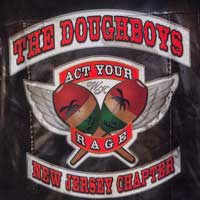
The Doughboys, Act Your Rage

September 23rd, 2010

Artist: The Doughboys
Title: Act Your Rage
Label: Ram Records 08-01
Released: January 2010
Genre: Rock / Garage Rock

Three of these band members cut a couple singles in Jersey in the 60s before they split up. Thirty–some odd years later, they regroup with a couple of new members and sound like they’re still in 1965.

When they cover the Kinks, they chose the cut, “It’s Alright.” It’s an early Kinks cut, more reminiscent of blues-based garage rock than the overtly English band they’d become. Lead singer Myke Scavone draws from the American blues from which it’s based, following the direction of Mick Jagger rather than Ray Davies. When he belts a ballad, like “Carmalina,” (the track I keep listening to over and over) he’s closer to Peter Wolf on the Geils’ debut album. On “Nobody’s Girl,” Scavone could be any of the lead vocalists on the first Nuggets collection.

What Scavone doesn’t sound like, is the lead singer of Ram Jam, the 70s band with the heavy version of Leadbelly’s “Black Betty;” which was produced by the bubblegum entrepreneurs, Kasanatz-Katz. But in truth, he was the pipes behind that song. Don’t let information influence your opinion of the band though. It’s just a bit of minutia, just like the fact that drummer Richie Heyman is the same person as power-pop performer, Richard X. Heyman.
buy tramadol
online tramadols
tramadol online

The album lags for four songs midway through. “Queen City” is straight-forward barroom rock, as is “12 Bars and I Still Have the Blues,” but they sound like something that might show up on a Bob Seger rarities collection. “Early Warning Wake Up Call” sounds more like an arena anthem and lacks the raw intimacy that most of the other cuts the CD delivers. “Desperate Delusion,” drops the names, Rodgers & Hammerstein and Jane Austen among others, that just don’t seem to cut it in my garage of rock.

But Scavone and the boys get back on track with the rave-up, “I’m Not Your Man,” which falls somewhere between the Yardbirds and Led Zeppelin. “Wishful Thinking” should make Tom Petty envious. The album closes with a cover of the Moody Blues, “Tuesday Afternoon,” a version that resembles the ‘what if the Moody Blues’ stayed true to their early R&B roots and forgot about all that bullshit orchestration?’
modafinils
purchase modafinil online

The only thing new to the band has to offer is that they do it right. Many of these throwback bands get the image and the proper gear, but it all sounds forced or over produced. The Doughboys experienced it and they still can play it. They sound honest. I’ve never seen them live, but if they ever come to town, I’m first in line.

It’s just four songs too long. Otherwise I’d give it an A.

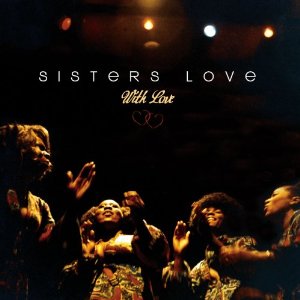
Sisters Loves, With Love; Love’s Gem

September 20th, 2010


Artist: Sisters Love
Title: With Love
Label: P&C
Genre: Soul; Funk
Release Date: September 14, 2010 (original recordings, 1972 & 1973)

Let’s be honest. The soul music of the late 60’s and early 70’s has been so thoroughly researched, analyzed and reissued that the discovery of heretofore unknown gems seems impossible. Then along comes an album like Sisters Love’s With Love to destroy that jaded notion. With Love brims with the fiery, soulful funkiness that characterizes the era’s prime recordings. And, with this set of recordings, lead vocalist Vemettya Royster stakes her claim for membership in the elite clan of female soul singers of the day.

Sisters Love was started by a group of former Raelettes, who had departed Brother Ray’s touring ensemble under varying circumstances, none of them happy. Led by Merry Clayton, the group established a loyal following with their live performances at Los Angeles area venues. The group early established a black pride identity, with colorful African inspired stage garb and Afro hairdos. In 1968, Sisters Love released a single on the tiny Man-Child label. Shortly thereafter, Clayton departed to pursue a solo career, and Royster was recruited to fill the lead vocalist role. Royster was not only a former Raelette and Ikette, but also was singing with the renowned gospel group, the Clara Ward Singers. In 1969, Sisters Love signed with A&M Records, where they recorded 6 singles, none enjoying notable success. After being dropped by A&M, the group signed, in 1972, with Motown’s nascent West Coast label, MoWest. With Love consists of Sisters Love’s recordings while at MoWest, from 1972 to 1973, which included four singles (the fourth of which was released only in Europe) and material for an album that was never released.

Throughout With Love, Sisters Love experiments with a variety of styles, but the constant that drives these recordings is Royster’s voice. She sings with a rough-hewn passion that at once invokes her gospel roots and her knowledge of more worldly matters. Not afraid to take risks, she shouts and wails her way through the all of the material at hand. The other Sisters provide a stunning choir in support, out-churching any competition. As one would expect, the production support at these Motown-conducted recording sessions is flawless, with excellent arrangements and solid playing.The album opens with a roar: a Sly Stone influenced reading of Bobby Womack’s “Communication.” An insistent bass line moves this funky groover, while Royster belts the socially conscious lyrics, calling to the response of the other Sisters in a manner reminiscent of Aretha’s “Rock Steady.” From social commentary, the Sisters next move to affairs of the – er, heart, with “Mr. Fix-it Man.” A sassy song squarely of the Jean Knight/Betty Wright school of unrequited desire, Royster warns her man:

“You’ve got to fix it, Mr. Fix-it man/If you don’t fix it baby, maybe the milkman can.”

The next cut, “You’ve Got My Mind,” heads into more atmospheric territory, with its conga and strings laden arrangement providing a backdrop for Royster’s remarkable performance, which renders lyrics almost irrelevant as she cries and moans against the harmonic chanting of her mates. Also in the atmospheric department is a revelatory re-working of Curtis Mayfield’s “Give Me Your Love,” a song from the Superfly soundtrack. Sisters Love tackles more standard Motown Sound fare with “Fast Mack” and “Just A Little Misunderstanding” (the latter having been previously recorded by the Contours and the Jackson 5). It’s just that when Royster takes righteous flight, the cool, calculated Motown vibe is threatened with incineration. This is no Mary Wells or Martha Reeves! Also worth singling out for mention is Sisters Love’s fearless assault on the Sweet Inspirations’ signature song. “Sweet Inspiration.” I love the original, but this slower, rougher and tougher rendition is glorious.

The only time the proceedings flag a bit is the rare occasion when Royster steps aside for one of her companions, as she does with “Do What You Gotta Do.” Lillie Fort takes the lead here, complete with spoken word intro, in a performance that, when compared to the other songs on the record, comes up flat (both emotionally and pitch-wise). This is a brief detour, however, on what otherwise is a road filled with the energy and passion of one of the great eras of American soul music. This is one of those collections of vintage, mostly previously unreleased material that truly qualifies for the moniker “gem.”

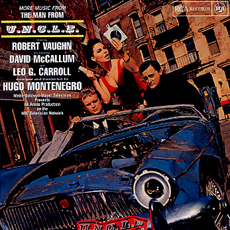
Hugo Montenegro, More Music From The Man From U.N.C.L.E.

September 17th, 2010

Artist: Hugo Montenegro
Title: More Music From The Man From U.N.C.L.E.
Label: RCA LPM 3574
Release Date: 1966
Genre: Soundtrack / Lounge / Spy Jazz

Woooo hooooooo! What a find! 60s spy soundtracks are the bomb and this is no exception. This is the second release of music from the TV series; a show that shifted from thriller to camp and the music reflects the turn.

There’s nothing wrong with the traditional cool spy jazz that usually accompanies this content. In fact as a genre, it is highly respected. But as the series became more playful, the music became more buoyant, incorporating sambas and bossas, elements of rock and a little bit of funkiness ala Quincy Jones. “Jungle Heat,” the killer track on the album, sounds as if Money Mark & the Q were responsible for the composition.

“Boo-Bam-Boo Baby” takes on a far eastern feel, sounding like a funky Martin Denny number. “Run Spy Run,” could have been the benchmark for the soundtrack to the TV Series, Police Squad!

The two songs on the album that remains close to the traditional spy-jazz style are “Lament for a Trapped Spy;” a number very close to the Earl Hagen standard, “Harlem Nocturne,” and “Jo Jo’s Torch Song,” a song in the cadence of the “Perry Mason Theme,” but not as hip.

Hugo Montenegro arranged and conducted both volumes of music from The Man From U.N.C.L.E. but oddly enough, he never contributed any original scores. Jerry Goldsmith wrote the three original scores for the series and was followed by his protégée, Morton Stevens. (Stevens’ greatest height of popularity came as the composer of the theme to Hawaii Five-0.) Then there came a brief period where Lalo Schifrin composed and then Gerald Fried came in and was responsible for seasons two through four. Other composers for the series included, Walter Scharf, Richard Shores, Nelson Riddle and Robert Drasnin. More Music From The Man From U.N.C.L.E contains compositions by Fried and Drasnin, only.

Within the genre of Lounge / Spy Jazz, this is a fine record. The record is somewhat collectable and I am fortunate to get it at such a great price. But, if you keep diggin’ through crates, sooner or later you’re rewarded.

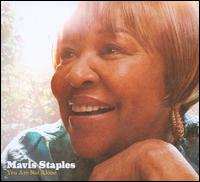
Mavis Staples, You Are Not Alone

September 15th, 2010

Artist: Mavis Staples
Album: You Are Not Alone
Label: Anti 87061
Release Date: September 14, 2010
Genre: Gospel / Soul

One reason I’ve always been a fan of southern soul music is because of the rich gospel tradition for which it is based. I’m not a religious man, but the elements of gospel, the emotional conviction, the voices, the blues that creeps into a guitar lick, resonate with my person. I have reached a personal crossroads when I listen to gospel, because I enjoy it so but have no religious convictions.

But when I listen to Mavis Staples, whether with her family band or her solo efforts, I never really hear it as gospel music. I know the hits on Stax were secular, but the messages were mini morality plays. When I saw her live this summer at Lollapaooza I told my family that if anybody could turn me to the Lord, it would be Mavis. When Mavis sings I hear honesty and conviction.  I don’t hear religion.

This is Mavis’ third album for the Anti label. Her first was the 20007 Ry Cooder produced, We’ll Never Turn Back. I found it a little predictable in the song selection, I liked the addition of the SNCC Singers on a civil right album, but it sounded a lot like a Ry Cooder record with Mavis singing. She had her name on it but Ry was driving the vehicle. His presence was overpowering.

I have to hand it to Jeff Tweedy for his production on You Are Not Alone. This is Mavis’ record. He contributed two songs on the release but they don’t sound like Mavis singing Wilco songs. They sound like songs Tweedy wrote with Mavis in mind. The title track is as close as you’ll get to hearing something washed in Wilco. And Mavis cleans it up. It’s one of the highlights on the album.

The album further defines the sound from the previous album, Live: Hope At The Hideout, a sound based around her father’s guitar style, but it’s definitely not Pops. It ventures there, like in the opening track, a re-interpretation of “Don’t Knock.” But it doesn’t live there. Holmstrom’s style is influenced by Pops, but it’s heavier. It works well adding grit to the gospel. Along with Holmstrom, It’s the same band of Jeff Turmes on bass, and drummer Steven Hodges from the Hideout disc. Donny Gerrard was added as a vocalist, harmonizing and sharing a lead on a song Little Milton made famous, “We’re Gonna Make It.”

The re-working of “In Christ There is No East or West” turns the traditional number into a gospel-folk piece. Her reading of Fogerty’s ”Wrote a Song for Everyone” elevates the work to new heights. When sung through Mavis,

Saw the people standin’ thousand years in chains.
Somebody said it’s diff’rent now, look, it’s just the same.
Pharaohs spin the message, round and round the truth.
They could have saved a million people, How can I tell you?

It’s a message of civil rights instead of an observation from the Woodstock generation. The song should be listed among the best of Fogerty’s during his days with Creedence Clearwater Revival, but it didn’t chart as well in comparison to the canon of CCR hits.

Mavis Staples is an evangelist, and her songs are her personal messages of morality. And if civility, love and perseverance are the cornerstones of her beliefs, I could be a member of her congregation.

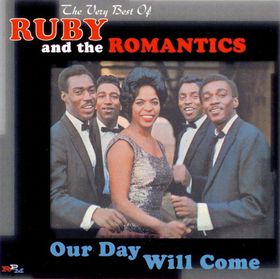
Songs I Turned Up: Rosie & The Originals – Our Day Will Come

September 15th, 2010

The song opens with the flourishing Hammond organ and the promise of a great future. “Our will come / And we’ll have everything / We’ll share the joy / Falling in love can bring.” It was 1963, and the tumultuous sixties were still young. The song rings of hope and happiness. To me, the song doesn’t only reflect the newness of young love, but an overall feeling of optimism.

This was also a time where there was an influx of Brazilian music. It had its affects on pop music. In ’63, Presley covered Tippie & The Clovers’ “Bossa Nova Baby” and Eydie Gorme recorded “Blame It On The Bossa Nova.” “Our Day will Come” had its bossa rhythm happening.

I heard the song on a 60s -70s soul station and it stood out. I wouldn’t say it sounded out of place, but it is remarkably different from “Cry Baby” by Garnett Mimms, or Ray Charles’ “Take These Chains From My Heart,” two other examples of soul songs from 1963.