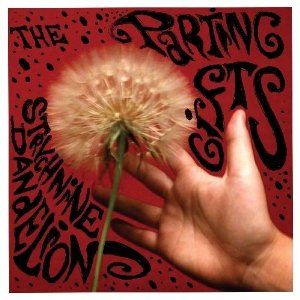
The Parting Gifts, Strychnine Dandelion

December 26th, 2010

And at number six…

Artist: The Parting Gifts
Titles: Strychnine Dandelion
Label: In The Red 201
Release Date: October, 2010

“Pursed lips still red with wine / Tell me lies as they’re touching mine” sings Coco Hames in “Bound” the second track of Strychnine Dandelion. Hames is also the lead singer of The Ettes. The composer of “Bound” is Greg Cartwright of Reigning Sound. Cartwright produced the previous Ettes record, which lead to the formation of The Parting Gifts.

The Parting Gifts is mainly the Ettes augmented by Cartwright on vocals and guitar, plus lending his tremendous songwriting talents. Ten of the fifteen tracks are Cartwright numbers, four are Coco’s and the other is a Stones cover – “Walking Through The Sleepy City.”

Cartwright writes it best in the cut, “Staring.” He sings, “A steady diet of broken dreams and aspertame,” which describes the album perfectly. Cartwright may have perfected melancholy garage rock. He writes and sings with his heart truly exposed but surrounded by sweet rock and roll hooks. The Coco Hames songs run from country-tinged rock to punk. She serves as a good muse for Cartwright who has developed a signature sound. Coco on the other hand shows she is still exploring and pushing musical boundaries.

Cartwright carries most of the vocal work, even singing on the Hames composition, “My Baby Tonight,” a smoky piece of early 60s influenced R&B. Sadly, “Bound” is the only track where Cartwright and Hames duet. Plus, the title track is better suited for Coco to sing, but Cartwright took the lead on it.

Nonetheless, it is another strong offering from Greg Cartwright. He doesn’t get the attention of someone like Jack White, per se. But as a person who bought every single White put out on his Third Man label this year, I’ll take the Cartwright creations over Mr. White’s.

Lee Scratch Perry & Adrian Sherwood, Dubsetter

December 26th, 2010

And at number seven…

Artists: Lee “Scratch” Perry & Adrian Sherwood
Title: Dubsetter
Label: On U Sound 126
Released: July 13, 2010

This is truly a sonic experience. Just when you think you know your dub, Adrian Sherwood and Lee Perry do it again. With the roots of this material lying in the 1990 Mighty Upsetter, the duo rework number from that LP to where the compositions take on new personalities.

1990’s “Yellow Tongue” becomes “Yellow Fever,” stripping away Samia Farah’s voice and replacing it with wandering violins. “Lee’s Garden” is morphed into “All Will Be Well In The Garden,” with a harmonica and a bowed cello in a dub surrounding. “Lucky Charm” becomes “Lucky Tarzan,” and so on, but these versions change dramatically with the presence of strings. You can also hear Sherwood’s influence with his dabbling into Asian dub.

A composition not included on Mighty Upsetter but still drawing some source material to compliment it is Ernesto and Margarita Lecuona’s “Taboo.” The song since its 1941 inception, has been recorded by lounge icons, Ferrante & Teicher, Les Baxter, Henry Jerome and Xavier Cugat among others. The Sherwood/Perry treatment sends the song to another genre, transcending all previous attempts.

The musicianship and production values surpass anything else I heard in 2010. It is rich and textured. It demands your attention while at the same time, sweeping you away into a trance.

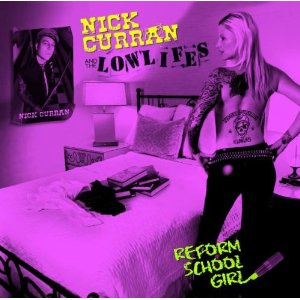
Nick Curran & The Lowlifes, Reform School Girl

December 26th, 2010

And at number eight…

Artist: Nick Curran & The Lowlifes
Title: Reform School Girl
Label: Eclecto Groove 509
Released: February 16, 2010
Genre: R&B, Rock

Not many albums start off covering a vintage Etta James and finish with AC/DC. In between are twelve originals that sound like Little Richard meets Phil Spector with a dash of sixties camp.

When I first head “Sheena’s Back In Town” I thought it was a lost R&B gem; maybe an unearthed King Coleman cut. The misogynistic “Kill My Baby” is frighteningly believable with a nasty guitar line and an adrenaline rush of rhythm fueled by a baritone sax. The cut is followed by, “Psycho” with schizophrenic vocal to match. Not even Esquerita sounded this nuts.

But then on cuts like, “Reform School Girl” you hear Phil Spector and sixties girl group camp with background vocals in the chorus that sound like the Modern Folk Quartet regrouped for the session. “Ain’t No Good” leans more toward the rockabilly side of the tracks, as does “Flyin’ Blind” (featuring guest vocals from the Blasters’ Phil Alvin) while “Dream Girl” is bound to show up in a Tarrantino film.

The retro sound is so real thanks to the production work of Billy Horton, a Curran’s bas player that puts Nick’s vision into sound. Curran’s career has had him playing with his father’s band in Portland, ME at nineteen. He also toured with the rockabilly mistress, Kim Lenz, was a member of the Fabulous Thunderbirds and has pursued a solo career with Reform School Girl being his fifth album.

Some artists love a sound and do what they can to mask themselves in it. Curran is the sound he wants. It is derivative but it’s done expertly. Listen to the cover of AC/DC’s “Rocker,” you’d think it was a Little Richard song.

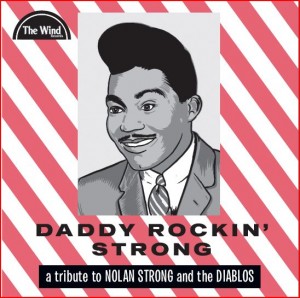
Daddy Rockin’ Strong: A Tribute to Nolan Strong & The Diablos

December 23rd, 2010

And, at number nine:

Artists: Various
Title: Daddy Rockin’ Strong: A Tribute to Nolan Strong & The Diablos
Label: The Wind 002
Released: September, 2010

Nolan Strong & The Diablos were not a band that was underappreciated by followers of vocal group harmony. To the general public though, they don’t have the recognition of groups like the Orioles or Moonglows. Only one of their singles broke nationally; “The Way You Dog Me Around” b/w “Jump, Shake & More,” hitting the number twelve position on the national R&B charts. But around Detroit in the 1950s, these guys were kings. They were a franchise group at the Motor City’s Fortune Records. Their 1954 single, “The Wind,” was rated the eleventh best Detroit record out of 100 in the Detroit Metro Times, nestled between “Kick Out the Jams” and “Smokin’ In The Boys Room.”

Nolan Strong was the link between Clyde McPhatter and Smokey Robinson. He was a master of the falsetto and also a great songwriter. The majority of the songs on Daddy Rockin’ Strong have come from the pen of Nolan Strong, and some from Devora Brown – a co-owner of Fortune Records. And knowing the practice of the music industry, I wouldn’t doubt that Nolan lent a strong hand in writing the Devora Brown numbers.

Daddy Rockin’ Strong is thirteen tracks in tribute to the Diablos, all covered by bands that have roots in sixties garage, but an obvious appreciation for Nolan Strong. One exception to that rule would be a surviving label mate of Strong’s, Andre Williams. In the past two decades, Andre’s musical spectrum has expanded, but in the sixties, he put out some gritty R&B. He covers Strong’s only national hit, “The Way You Dog Me Around.”

The album opens up with “The Wind,” a strangely produced cover by Mark Sultan, the other half of King Khan & Bab-B-Q. It’s literally fingernails on the guitar strings, sliding up and down the fretboard creating an eerie ambiance behind Sultan’s falsetto.

The Dirtbombs contribute the title track, which is a twist (a polite euphemism for rip off) of “Daddy Rolling Stone.” Greg Cartwright’s Reigning Sound rocks a version of “Mind Over Matter,” one of the more popular tracks amongst Strong followers. In fact the A-Bones riff on it in the closing of their cover of “Real True Love.”

Guitarist Lenny Kaye, the compiler of the great Nuggets collection and member of Patti Smith’s band performs the ballad, “I Wanna Know.” Wreckless Eric & Amy Rigby to a fine interpretation of “I Wanna Be Your Happiness,” sounding like a new millennium Mickey & Sylvia. And from beyond the grave, Cub Koda, another Detroit rocker, a founding member of Brownsville Station, contributes, “You’re The Only Girl Delores.” The song was originally released in 1994 on is album, “Abba Dabba Dabba.”

There were some good tribute albums released in 2010. Broken Hearts & Dirty Windows, the John Prine tribute record was very good, as was Twistable, Turnable Man the Shel Silverstein collection. But I’ll take the Daddy Rockin’ Strong as my favorite tribute record of the year. The record rocks (And it’s available on clear vinyl for a price). It shows Strong’s recognition of a good hook. It also displays a great cast of musicians that definitely have a strong feeling for the Diablos.

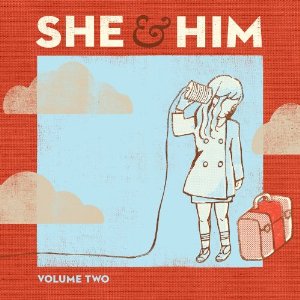
She & Him, Volume Two

December 22nd, 2010

Artist: She & Him
Title: Volume 2
Label: Merge 354
Released: March 23, 2010

If you’re not aware of She & Him, the She is part-time actress/part-time singer-songwriter, Zooey Deschanel and the Him is the well-respected M. Ward. Together they make beautiful pop songs.

But for many strange reasons, people won’t accept Zooey Deschanel as a singer-songwriter. Personally, I like her better as a musician than I do an actress. I liked Elvis Presley better as a singer than an actor. Madonna, no doubt she’s better in the music business than in film. I like Tom Waits in both roles. Dean Martin too. The point is, crossing over is not a new concept.

I was waiting in line at the Electric Fetus on Record Store Day. I was listening to my iPod. The customer next to me asked me what I was listening to and I told him, the new She & Him record. He made it clear that he did not like Zooey Deschanel, claiming that she had no talent and got a record deal mainly on her good looks. He had no interest in listening to the record based on that belief. I told him that I hoped he enjoyed his Susan Boyle album.

Get over it people! I can see if you don’t like 70s influenced pop music you can dismiss this as a matter of taste, but to base it on pure jealousy is pretty damned ignorant.

I’ll admit, Zooey doesn’t have the range of a great vocalist, but she works very well within her limits. With writing eleven of the thirteen songs, they do, for the most part, fit within her range. The production work of M. Ward also keeps the listener interested, layering sounds upon sounds with subtle guitar fills, hand claps, bells, chimes, bongos and sweet harmonies.

Right in the middle of the album, the track “Home” opens up with a piano riff, reminiscent of the 70s L.A. singer-songwriter sound. The song then drifts into late 60s Beach Boys territory and than falls comfortably into a little romp. It’s complex in structure but yet it doesn’t sound too busy.

M. Ward’s production should be commended. The sonic roots are obvious and he dresses up some very simple pop songs into elaborate works. “Brand New Shoes” rings of Brazilian pop, with it’s acoustic guitar in the forefront and the cadence of Deschanel’s delivery.

The opening track, “Thieves” riffs on Patsy Cline’s “Strange” but has production bigger than Owen Bradley’s. “In The Sun” is close to a perfect pop song and “Lingering Still” touches more on 60s Countrypolitan than most tracks on the album.

The covers are expertly chosen too. “Gonna Get Along Without You Now” was a hit for Skeeter Davis, keeping that 60s country-pop flair alive. NRBQ’s “Riding In My Car” is a classic song about cars and girls, it could be the lost gem of Brian Wilson.

The album is not perfect, “If You can’t Sleep” shows Zooey’s shortcomings in holding a note in a slow song. “Don’t Look Back” marches along, and I just don’t like marches (unless there’s a brass band funkifying it.). But the great songs outshine many of their charting contemporaries making it one of my favorite albums of 2010.

Watch the video for “In The Sun”

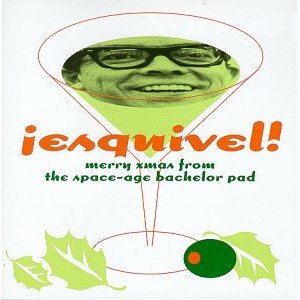
Merry Xmas from a Space-Age Bachelor Pad

December 21st, 2010

On the fifth day of Christmas, my true love gave to me…

Artist: Esquivel
Title: Merry Xmas from the Space-Age Bachelor Pad
Label: BMG/Bar None DRC1-1363
Released: 1996

Although released in 1996, this is a collection compiled from Esquivel’s recording made between 1959 and 1962. For those not familiar, Esquivel was an over-the-top arranger, an Ellington without limits living in a space-age bachelor pad.

“Frosty the Snowman” zu-zu zooms throughout the town over a swinging xylophone, harpsichord, and bending pedal steel, with the guitar borrowing more from Warner Brother’s cartoon sound affects than country music.

Two of the tracks feature the vocal quintet, the Skip-Jacks, which included Stella Stevens as one of the singers. They tend to anchor the mania that is Esquivel. They’re ‘everything is gleeful” approach to melodies are nostalgic memory attributed to the late-50s-early-60s bursting at the suburbs America.

Esquivel swings more than the Three Suns, mostly from the absence of the tuba. It was a manufactured ‘cool’ in the land of housing development cocktail parties, kidney shaped coffee tables and tropical barware. It’s 28 minutes of a time that did exist that we now distort through rose-colored black-rimmed glasses. although our vision may be distorted, Esquivel’s was clear, but maybe only to him.

Ronnie Spector’s Best Christmas Ever, December 20, 2010

December 21st, 2010

Artist: Ronnie Spector
Venue: The Dakota
Date: Monday, December 20th 2010

Before Ronnie came onto the stage, the band opened with a version of Solomon Burke’s, “Presents for Christmas.” This show was billed as “Ronnie Spector’s Best Christmas Ever,” so it wasn’t a stretch nor a surprise to hear a holiday cover to open a show. I was lukewarm to her new Christmas EP. All I really expected was a good version of “Be My Baby” and I would have felt like I experienced a piece of rock and roll history.

I got a hell of a lot more.

When Ronnie took the stage, the atmosphere changed. Her smile beamed and her eyes , nearly covered by her bangs, twinkled. About five songs into the night, she covered Amy Winehouse’s “Back To Black,” relaying a story of how she performed it in London, while Ms. Winehouse was a member of the audience. She told Amy in her New York accent, like a teenager on the telephone, that she was wearing her hair wrong. The correct Ronette-inspired beehive is supposed to be upright, not tilted. Ronnie said the following night, Amy’s hair was right.

“Back To Black” was a cover I didn’t expect to hear, in fact, there were a lot of numbers I didn’t expect to hear. The flow of the show was expertly constructed, drawing for all stages of Spector’s career, interspersed with Christmas music. “Back to Black” seamlessly segued into “You Baby,” a lesser known Ronettes number with an elegant melody. The juxtaposition of the two numbers exhibited the influence of Ronnie Spector on contemporary music and also reminded us that the Ronettes had some great cuts that don’t get the airplay or attention as some of their hits, but yet they are magnificent numbers.

After “Frosty the Snowman,” Ronnie introduced the Joey Ramone number, “She Talks To Rainbows.”  It finally hit me at that moment, what an influence she had on Joey Ramone’s singing. Part of it is a “New York thing,” and of course, you had the Phil Spector produced End of the Century album. And then there were the Ramones bangs, just barely covering the eyes, just like Ronnie’s that evening.

Ronnie spoke of her influences too, especially doo-wop, which she seemed very enthusiastic to perform. Her version of the Students, “So Young” (which the Ronettes did cover during their prime) made you believe that she was performing this out of pure love for the song and genre.

To top things off, Ronnie’s bad was great. The drummer hit hard, sounding like a multi-tracked Hal Blaine, gaining a great groove with her bass player. The guitarist never overplayed, the two keyboardist did their best with modern technology to mimic the bells and whistles of the Wall of Sound, but most importantly, she had a great pair of…back up singers. (If you saw the show, you thought I was going to say something else, didn’t you?)

When I found myself singing along to some of the numbers, I was singing the back up parts; the oooohs and ahhhhs and ohs. Those voices are just as much of the musical canvas as other instruments in the band. They’re a lot like a string section, adding this layer of buoyancy for the music to flow. The front man of a band always gets more attention, but Levi Stubbs would sound naked without the Three Tops, and Gladys Knight’s songs wouldn’t pop without the Pips. And to hear Ronnie without a couple of other women on stage, just wouldn’t be the same.

Ronnie talked about a long running engagement she had at a gay bar in New York City. One night she saw a man weeping in a corner booth. It was Johnny Thunders.  She then did a knock out version of “You Can’t Put Your Arms Around A Memory.”

She did her share of name dropping throughout the night, but it felt really genuine. She was friends with John Lennon. Joey Ramone produced an album for her. She knew Johnny Thunders, and of course, she even kidded about Keith Richards (she seems to have a penchant for making friends with junkies). All those relationships were reminders to us that there was a career after the Ronettes and she embraces all parts of her tenure during her performance. And it was great.

She closed the show with “Be My Baby” obviously recognizing the power of that number. You got to leave them wanting more. For an encore, she came out wearing a sexy Santa smock to sing “I Saw Mommy Kissing Santa Claus, followed by Lennon’s “Happy Xmas” and closing the night with “I Can Hear Music.”  “I can hear music, sweet, sweet music. Whenever you touch me, whenever you’re near.”

Grade: A
Here’s the setlist:

The band opened with “Presents for Christmas” and then…

1. My Christmas Wish
2. Is This What I Get
3. Girls Can Tell
4. Christmas Once Again
5. Back To Black / You Baby
6. Do I Love You
7. Paradise
8. Frosty The Snowman
9. She Talks To Rainbows
10. Baby I Love You
11. So Young
12. Keep On Dancing
13. Sleigh Ride
14. Please Say You Want Me
15. Best Christmas Ever
16. Walking in The Rain
17. The Best Part of Breaking Up
18. You Can’t Put Your Arms Around a Memory
19. Be My Baby

Encores:

20. I Saw Mommy Kissing Santa Claus
21. Happy Xmas (War Is Over)
22. I Can Hear Music

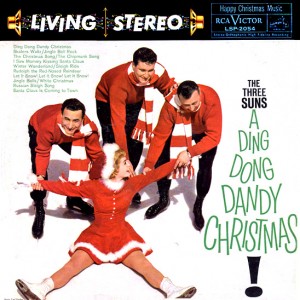
A Ding Dong Dandy Christmas

December 17th, 2010

On the fourth day of Christmas, my true love gave to me… 

Artist: The Three Suns
Title: A Ding Dong Dandy Christmas
Label: RCA LSP-2054
Released: 1959
Genre: Lounge

This is the most manic Christmas album I’ve ever heard. Bells, chimes, accordions, tubas, electric guitars, harmonizing brass, harmonicas, organs and xylophones all deliberately arranged to drive you nuts. The only thing missing are the bagpipes and Jaw Harps. It’s strangely beautiful and upsetting at the same time; just like Christmas can be. And it’s all brought to you in the magnificence of RCA’s Living Stereo brand, an experience in stereo-orthophonic high fidelity recording.

They totally deconstruct “White Christmas” and put it back together with an Erector Set. “Santa Claus Is Coming to Town” sounds like a polka band covered it after dropping acid. “Jingle Bells” sounds like it was interpreted by The Schmenge Brothers with the Happy Wanderers. I’m craving cabbage rolls and coffee right now.

The sonic spectrum spanning of “Russian Sleigh Ride” with the rhythm provided by the tuba and the melody chimed on bells morphs into  spy jazz for a moment and then back to a typical Three Suns sound, which is not typical at all.

If you want to add confusion to your holidays, I highly recommend this album. It’s good at clearing your house of guests. The risk you take is there may be a visitor who will want to hear the whole damn record. Follow the record up with Esquivel’s Christmas album to bring back some semblance of order.

Merry Christmas Baby

December 16th, 2010

On the third day of Christmas, my true love gave to me…


Artist: Various
Title: Merry Christmas Baby
Label: Gusto K-5018X
Released: 1978
Genre: R&B

Gusto mined the vaults of King, Federal and Hollywood Records to assemble this collection. This budget line album from Gusto Records album leads of with another version of Charles Brown’s “Merry Christmas Baby.” But after that, the only holiday standard you’re going to find among the 16 tracks is Bullmoose Jackson’s version of “I’ll Be Home For Christmas.”

And don’t be fooled by the Jackson Trio’s “Jingle Bell Hop” or Lloyd Glenn’s “Sleigh Ride.” They only share the names of more popular holiday songs. But that’s not to say they don’t pack the same holiday cheer. “Jingle Bell Hop” is actually a honking sax version of the ”Jingle Bell” riff.  “Sleigh Ride” has no resemblance to the Leroy Anderson composition. They’re both angular instrumentals sharing that same characteristic to remind us it’s a Christmas song; the rocking sleigh bells.

Mabel Scott’s 1948 recording of “Boogie Woogie Santa Claus” saw enough airplay to warrant a cover by Patti Page in 1950 and also a Brian Setzer version in 2002.  I’ll stick with Maybelle’s version, Patti’s was a cover with nothing changing in the arrangement except the ethnicity.

Other artists included on this collection Freddy King, Johnny Moore’s Blazers, Lowell Fulson, Jimmy Witherspoon and Billy Ward and his Dominoes. There have been a multitude of R&B Christmas collection compiled on CD and in 1988, most of these tracks showed up on a collection called, Rhythm & Blues Christmas (not to be confused with the LP from 1978) but it also contained some crap. If you can find this re-issue, or the original King press from 1961 or 1962, those would be the ones to get.

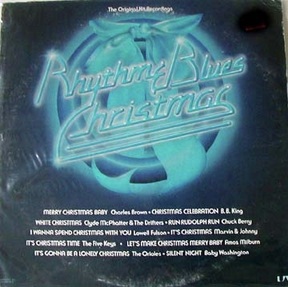
Rhythm & Blues Christmas

December 16th, 2010

On the second day of Christmas, my true love gave to me…


Artists: Various
Title: Rhythm & Blues Christmas
Label: United Artists UA-LA654-R
Released: 1976
Genre: R&B

Rhythm & Blues Christmas runs the gamut of the broad title, offering blues, doo-wop, vocal group harmony and rock and roll. It’s a good primer for an R&B neophyte.

The album leads off with one of the many versions of Charles Brown’s “Merry Christmas Baby,” (I believe its from the 1956 Aladdin session). No matter what version of it by Mr. Brown, it is the all-time R&B Christmas standard. It sets the tone for the remainder of the album; this is benchmark, let’s see how the other tracks stack up.

Baby Washington’s “Silent Night” isn’t Big Maybelle’s version, but it fits well in this collection. We used to sing “Silent Night” in church when I was growing up, but our church never had the church that Baby Washington brings to this carol.

The next track is “White Christmas” by the Clyde McPhatter lead Drifters. Some people will argue with me preferring to hear this jingle by Der Bingle, but I’ll take the Drifters version any day. I like the cadence of the doo wop better for this holiday number. The interplay between McPhatter and the bass of Bill Pinkney is just plain joyful.

The doo wop slows itself down to a near halt, drifting more into the vocal group territory with the 1951 version of the Five Keys’ “It’s Christmas Time.” It’s a nice contrast to the Drifters take on Christmas. The Keys owe more to the sound of the Ink Spots than the doo wop that would become prevalent in the later years of their recording career. With lyrics stating, “…our dream cottage…” and “…we loved in a younger prime…” the sentiment is from a different generation than what the Drifters represented.

Side one ends with the Chuck Berry rocker, “Run, Rudolph Run.” It too is an R&B Christmas standard, but on the other end of the spectrum in relevance to Charles Brown’s “Merry Christmas Baby.” In fact, it was music like this that made Brown’s career fade in the sixties. Brown and Berry are a couple of good bookends to side one.

Side two breaks out with the big band blues sound of B.B. King. Originally recorded for Kent in 1966, King’s signature guitar is augmented by a driving horn section. Nearly crossing over into soul music, it is a good companion to Lowell Fulson’s “I Wanna Spend Christmas With You,” which shows up later on this side. Fulson’s number was also recorded for Kent, his in 1967, making these two cuts the most “modern” representations of R&B on the album.

Back in the vocal group vein we have one of the leaders of all the bird groups, The Orioles with (It’s Gonna Be A) Lonely Christmas.” Only the Ravens could challenge the Orioles for supremacy amongst the R&B warblers. The Orioles built the bridge between vocal group harmony and doo-wop and nested highly upon it. The flipside of this release in 1949 was “What Are You Doing New Year’s Eve,” which is sadly not included in this collection.

“Let’s Make Christmas Merry, Baby” by Amos Milburn was also recorded in 1949. It is more in the style of Charles Brown’s cut but lacks the refinement. Not to say it is not smooth, but in comparison, you can hear the wonderment of Brown’s voice.

The album closes with Marvin & Johnny’s “It’s Christmas.” It is closest in style to The Drifters but recorded in 1957, three years after “White Christmas.” It exemplifies a shift from doo-wop to straight R&B.

The album succeeds at providing the listener with a survey of R&B styles, they just so happen to be all holiday numbers. If you have the desire to hear some classic R&B Christmas tunes, dig through the used bins at your local record stores. The artwork is rather cheesy so it is often overlooked as a poor quality budget album. It is not. It’s worth the quest.