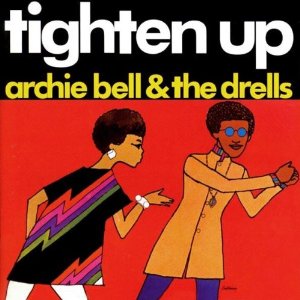
 The summer of 1968 was, as always, hot and sticky in the middle plains town where I spent my youth. Taking American History for summer school meant attending class in the old, non-air conditioned high school downtown. It would, however, defuse pressure to get a job, and make for a lighter schedule come the school year, so I went for it. My non-air conditioned car had only an AM radio, and the town’s Top 40 was in a particularly brutal phase – Bobby Goldsboro (“Honey”) duking it out with Gary Puckett (“Young Girl”) for top spot in the rotation. That made for a whole lot of “Honey.” That summer was made bearable only by the emergence of “Tighten Up.”
For me, the arrival of “Tighten Up,” by Archie Bell and the Drells, began subliminally. The first time I actually listened to the song, I must have already heard it a dozen times on the radio. It had no melody and only two chords, but it had that funky bass line, and the syncopated organ and rhythm guitar lines gave it an infectious beat. There was the stop, with the singer’s command to “make it mellow,” followed by the distinctive brass phrase that served as the song’s signature. There were also other words – sort of, difficult to decipher, something about “Houston, Texas” and repeated urgings to “tighten up.” As the song rose up the charts, I found myself walking the hallways at school to its rhythm, playing over and over in my head. I found myself driving the steaming streets with the windows down, and the radio up, at least when “Tighten Up” was on. The record seemed like a hot, sweaty party, and during that hot, sweaty summer, I was ready to join in. A lot of folks felt the same way, apparently, as the record went to No. 1 on both the R&B and pop charts. For us, “Tighten Up’ WAS the summer of 1968.
Curiously, “Tighten Up” has, since that summer, survived and even thrived. Indeed, this simple two chord piece of pop-funk has provoked cover versions from a wildly diverse array of artists, from Latin soul purveyor Al Escobar to alt-rockers R.E.M. to Japanese techno geeks Yellow Magic Orchestra. My purpose here is to survey this multitude of “Tighten Up” covers. But first, let’s explore a bit of background about the song.
The Song & The Record.
The authorship of the song is the subject of some controversy. It is, for legal purposes, attributed to Archie Bell and Billy Buttier (actually, Bell’s good friend Billy Butler). At least one source asserts that Bell & Butler wrote the song in 1964, and that Bell and the Drells recorded a demo of the song, which “was soon forgotten.” More likely, in my view, is the story told to the Houston Press by Skipper Lee Frazier, the Houston D.J. (WCOH) and record man who was Bell’s manager, and who produced the session from which “Tighten Up” emerged. According to Frazier, “Tighten Up” began as an instrumental jam played at dances by the TSU Toronados, a popular R&B band in the Houston area, many of whose members attended Texas Southern University. The two chord groove with the “mellow“ horn interlude, routinely packed the dance floor. Frazier went to a club and heard the Toronados play the song at the behest of a band member, who told Frazier that this tune would make a great record, but they didn’t have lyrics yet.
Shortly, in October, 1967, Frazier brought the Toronados into the recording studio along with Bell and the Drells with the idea of making just such a record. Frazier had previously released an Archie Bell and the Drells record to moderate local success. Bell claims that the idea of calling the record “Tighten Up” was his, inspired by dance moves created by his buddy Butler. The term “tighten up” was part of everyday Houston slang, and with his moves Butler proclaimed he was doing “the tighten up.” Members of the Toronados, however, say that they were calling their jam “Tighten Up” well before arriving at the studio. There is also a dispute about the source of the words “sung” by Bell – though those words would scarcely qualify anyone for poet laureate status (!). Frazier says he “dictated” the words to Bell while driving him to the studio. Bell says that he wrote the words himself. At least one Toronado says that Bell was fed the lines by a band member during the session. In any event, Bell and Butler ended up with the songwriting credit (with Frazier owning publishing rights).
Ironically, it took 25 to 30 takes to capture what sounds like a totally spontaneous “party in the studio” record. Frazier released it on his Ovide label as the B-side of a record that featured “Dog Eat Dog.” After Frazier followed the advice of a fellow D.J. at WCOH and flipped the record over to play the “Tighten Up” side, the record exploded into a monster hit in Houston. Gulf Coast record man Huey Meaux (better known as the Crazy Cajun) brought the record to the attention of Jerry Wexler at Atlantic Records in New York, who immediately pronounced it a “great record.” Arrangements were made and “Tighten Up” was released nationally by Atlantic, roaring to national success and record immortality. In the wake of this success, Bell and the Drells went on to gain stature as national recording artists, especially after joining forces with the Philadelphia-based production team of Leon Huff and Kenny Gamble and releasing hits like “I Just Can’t Stop Dancing” and “(There’s Gonna Be A) Showdown.” For their part, the TSU Toronados recorded a number of sessions with Atlantic (and Atlantic-affiliated Volt, part of Memphis’s Stax records group), which yielded but one chart entry, the instrumental “Getting The Corners” (which strongly evokes “Tighten Up”). They disbanded a few years later.
The Dance
“Tighten Up” was a dance as well as a song, a common phenomenon during the 1960s. The dance has not endured like the record, but there is a video of Bell and especially the Drells demonstrating the dance while performing the song that can be readily viewed on YouTube. I’m unsure of the date, but judging by their complexion, those are not the TSU Toronados playing the instruments.
The Covers
This is not an attempt to be absolutely comprehensive on the subject of “Tighten Up” cover versions. For example, all kinds of people post all kinds of songs on YouTube, covers of “Tighten Up” included. If you’re interested in seeing the Japanese kids in Monica & the Flower Sunset trying to conquer the rhythm of this song, or the bald middle-aged guys in the Vel Crows rocking out with it, be my guest. My goal is to offer a survey of what I believe are the interesting, worth a listen, covers of this classic. I would definitely be interested to hear about any omissions – this blog has a comment section just for such things!
Archie Bell & the Drells
“Tighten Up (Pt. 2)” (from the album Tighten Up, released by Atlantic in 1968). It is part of the “Tighten Up” legend that the success of the record coincided with Archie Bell’s being drafted into the Army, which led to him being stationed in Germany. As “Tighten Up” stormed up the charts, Bell made it back to the States on several weekend passes, where he spent his time recording more material for inclusion on an album that Atlantic was anxious to release. April, 1968, found Bell back in Houston in the studio with the TSU Toronados, cutting “Tighten Up, Pt. 2.” Starting off with Bell announcing “Here we go again!,” “Pt. 2” is most notable for the fact that, unlike its predecessor, the Drells are heard, harmonizing on the phrase “do the tighten up” behind Bell’s singing. This refrain was seized upon in many of the cover versions soon to emerge. Otherwise, the same party groove as the original is maintained, as Bell breaks the song down and calls on each instrument to “tighten up.” In subsequent pressings of the “Tighten Up” single, “Pt. 2” replaced “Dog Eat Dog” on the B-side.
Note: This song can be found on the 2004 two album CD reissue of Tighten Up & I Can’t Stop Dancing on Rhino Records – 5046-76155-2.
“Tighten Up At The Disco” (from the album Strategy, released 1979). Although Archie and the boys enjoyed continued commercial success into the 70s, by the time that Strategy was released on Philadelphia International, their run was coming to an end. The group had previously borrowed aurally from their initial hit (for example, “Real Good Feeling” from 1977’s Philadelphia International album, Hard Not to Like It, has elements of “Tighten Up” in it), but this was the first time that the title was invoked. There is only a passing resemblance between this “Tighten Up’ and the original. The “At The Disco” is what this number is all about – from the whomp, whomp of the rhythm to the manufactured-sounding vocal back-up. Archie, as usual, is gamely exhorting his audience to get down on the dance floor. True, this is a two chord riff, but the second chord is clearly not the jazz-infected one that added so much interest to the original. True, there are horns repeating a vaguely familiar line towards the end of the cut, but it is nowhere close to that signature horn figure that “made it mellow” on the original. Mainly, there is inane repeated chanting of the phrase that is the track’s name. This is a lower mediocre disco record, best not associated with Bell’s original.
Note: “Tighten Up At The Disco” can be heard on a 2006 three album reissue double CD set issued by Edsel Records (UK) – MEDCD 811: Where Will You Go When The Party’s Over / Strategy / Hard Not To Like It.
James Brown & the JBs.
“Tighten Up” (from the album Say It Live And Loud – Live In Dallas, August 26, 1968.” It didn’t take James, or perhaps it was Maceo Parker, long to jump on this one! It’s speculated that Parker was looking for opportunities to let individual band members shine before the audience, something in which his employer often seemed disinterested. This sizzling 7 minute plus second set opener provided such an opportunity, especially for trumpeter Waymon Reed. This track is “Tighten Up” on steroids. The tempo is brisk. In contrast to the “party in the studio” feel of the original, this “Tighten Up” is all business (I wonder how much the bass player got fined for his false start as Clyde Stubblefield is finishing “tightening up” on the drums). And, giving all due respect to the TSU Toronados, these JBs of reed men Parker, Pee Wee Ellis and St. Clair Pinckney, trombonist Fred Wesley, drummer Stubblefield and guitarist Jimmy “Chank” Nolan were at the summit of the R&B performing world of the day. Reed blows a blistering trumpet solo, Nolan is a machine scratching out the rhythm and Parker ably handles the “vocals,” as the JBs simply lay down the law on this number. Awesome.
Note: This track can be heard on a 1998 CD release Say It Live And Loud – Live In Dallas, August 26, 1068 issued by Polydor – 314557668-2. It can also be heard on a 1993 2-CD compilation on Polydor, James Brown: Soul Pride — The Instrumentals, 1960 – 1969 – 314 517 845-2.
Billy Ball & the Upsetters featuring Roosevelt Mathews
“Tighten Up” (aka “Tighten Up Tighter”). King single 5173. Also from 1968, this 2:12 burst of funkiness was recorded in Nashville for King Records. Billy Ball & the Upsetters was an Indianapolis outfit that had experience touring with acts like Rufus Thomas and also had released a number of records on the King-related Starday label. Roosevelt Mathews was their singer at the time, known for his large size and his showmanship. He turns in an assured performance on this track, including a “Night Train” style roll call of all the cities where they’re doing the tighten up. Ball, the keyboard player, at first seems inclined to noodle rather than devoting his efforts to the rhythm at the core of the song, but later seems to settle in. It’s a nice touch to try to structure this track as a follow up to the original – Mathews urging everyone to tighten up tighter. I was relieved to see that the songwriting credit, however, goes to Bell & Butler. Great energy level all through the cut. It’s a keeper.
Note: This track can be heard on a 2000 compilation CD release …King Funk issued by BGP/Ace Records (UK) – CDBGPD 135. It can also be found on a 2001 compilation CD release The Funky 16 Corners issued by Stones Throw Records – STR2038.
Benny Gordon & the Soul Brothers
“Tighten Up” (from the 1968 album Tighten Up on Hot Biscuit (distributed by Capitol). Gospel singers Benny Gordon and his brother Sammy moved to Brooklyn from their home in Estill, South Carolina in the early 60s. Once there, they decided to “cross over” and formed the Soul Brothers. They made a number of soul records for small New York labels (and, later, some larger ones, like Wand and RCA) and became the house band at Trudi Heller’s club on Sixth Avenue in Greenwich Village. That gig led to them being hired to perform at Truman Capote’s legendary Black & White Ball at the Plaza Hotel in 1966 (where, according to Gordon, none other than Frank Sinatra got up to sing with the band). In 1968, Gordon and the Brothers released an album of predominantly cover songs, with “Tighten Up” leading off the record. Like James Brown’s cover, it is immediately evident that this is a professional, working band on the job. After the drummer slams out the opening bar, a relaxed Gordon announces: “Hi everybody — we’re Benny Gordon and the Soul Brothers from little old Brooklyn, New York…” After issuing some dance step instructions, Gordon breaks it down with drummer, bassist and guitar player each tightening it up. Eight bars of instrumental oddness follows – some kind of funky interlude that leads straight back to the horns (heard for the first time) “making it mellow.” The basic “Tighten Up” groove kicks back in with a vengeance, this time with the horns blaring in rhythm with the guitar part. Gordon starts urging everyone to “Tighten Up!” as we ride the pulsating groove to the end of the record. Great stuff.
Note: The Tighten Up album has not been reissued. Unless you stumble across one used, the best way to hear this song is on YouTube.
Major Lance
“Do The Tighten Up” Dakar single 1450. Another entry from 1968, this record is related to Archie Bell’s original in name only. Though clearly intended to capitalize on the popularity of “Tighten Up,” the words and music are entirely distinct. In fact, the only musical allusion to an earlier record is a brief nod to Lance’s own “Monkey Time” (Lance asks the listener “Are you ready?” midway through the track). Viewed on its own, the song is a not unpleasant 2 minutes of sprightly, light funk-inspired soul. It is a long ways, however, from matching the joyful thrill of Lance’s earlier Curtis Mayfield-penned hits.
Note: This track can be heard on a 1999 compilation CD The Class Of Mayfield High issued by Westside Records (UK) – WESM 581.
Orchestra Harlow
“Horsin’ Up” (from the album Orchestra Harlow Presenta Ismael Miranda released in 1968). “The Horse” by Cliff Nobles & Co., of course, was another hot R&B and pop record that sold a million copies in 1968. This mash-up of “Tighten Up” and “The Horse” is the work of veteran Latin pianist, record producer and bandleader Larry Harlow, and young Puerto Rican singer Ismael Miranda. It was marketed as a “boogaloo” or Latin soul record, though to my ears this sounds at most 20% Latin and at least 80% R&B. The record contains far more “Tighten Up” than “The Horse,” the signature riff of which makes an appearance only twice during the course of the proceedings. As a Jewish guy from Brooklyn, Harlow had worked hard to gain acceptance into the inner circles of Latin music in New York. He reportedly hated making boogaloo records, preferring more traditional Afro-Cuban styles. Nevertheless, this record has irresistible charm, due in large part to Miranda. He seems to be winking, as he tells the listener about this “new dance” he is presenting, and no doubt grinning as he suggests “Maybe we’ll have a hit!” The music is rhythmically solid, with a brief turn from the trumpet and soulful harmony backing vocals taking the record out. Mr. Harlow may not regard this song as a worthy part of his legacy, but a lot of us are delighted that he made it!
Note: This song can be heard on the 2008 CD reissue of Orchestra Harlow Presenta Ismael Miranda by Fania Records – 773130 363-2. It can also be heard on the 2000 compilation CD Nuyorican Roots on Soul Jazz Records.
Al Escobar & His Orchestra
“Tighten Up” (from the album El Sondido Moderne De Al Escobar – The Modern Sounds of Al Escobar) released in 1969). Escobar, Columbian by birth, cut his musical teeth in New York, but then moved to California (where among other things, he was the musical director for Eartha Kitt!). This album is a New York recording, however, and it bears the trademarks of the Latin soul albums of the era – including covers of “The Horse” and an unlikely medley of “Judy In Disguise,” “Black Is Black,” and “Chain Of Fools.” Escobar’s best known song, “Ape Walk,” is also found here (and also appears on a number of boogaloo compilations). This treatment of “Tighten Up” puts the horn section in the spotlight from the beginning. The bandleader exhorts the listeners to “”tighten up, baby” throughout the track and reminds that these are the “Escobar sounds for ’69.” As you would expect, the drums and percussion play a dominant role throughout. There are no instrumental solos, but harmony vocals enter the fray for the second half of the cut with the “Tighten Up Pt. 2” refrain. A solid, if not particularly exciting version.
Note: This song can be heard on the 2000 CD reissue of El Sondido Moderne De Al Escobar on Tico Records – TRSLP 1184.
Sonny Bravo
“Tighten Up” (from the album The New York Latin Scene With Sonny Bravo: You Gotta Turn Me On) released on Columbia in 1968. By 1968, pianist and arranger Bravo had a rich background in Latin music. The son of a Cuban bassist with Conjunto Caney, Bravo had toured as a member of Tito Puente’s Latin Jazz Ensemble, among other gigs. Like others (including Puente himself), Bravo found himself making boogaloo records in the late 60s, including this take on Archie Bell’s hit. This record is notable for its inventive reworking of the signature horn riff, and also for its change in tempo, about 2/3 of the way through, to a more characteristically Latin beat. The change coincides with the harmony singers altering their lines from the familiar “do the tighten up,” to the Spanish “apretado” (which means to tighten down, or squeeze). A clever twist that makes this record more than worth a listen.
Note: This song can be heard on the 2001 CD reissue of The New York Latin Scene With Sonny Bravo: You Gotta Turn Me On on 101 Distribution records. It can also be heard on the 2006 compilation CD Tighten Up – Latin Jazz Lounge, released by Columbia (JP) – MHCP 1111.
The Majestics
“Tighten Up” (from the album Here Come Da Judge released in 1968 by Arc Records). The pride of Toronto, the Majestics was a covers band doing predominantly soul instrumentals. They released, for example, an entire album of instrumental covers of Otis Redding songs. This approach could succeed when the band brought some measure of inventiveness to its arrangements. Unfortunately, this cover of “Tighten Up” is barren of a single shred of originality. Keyboard, bass and drums mechanically repeat the basic riff, while the horns make a brief appearance for the “make it mellow” figure. Bordering on grocery store music.
Note: This song can be heard on the double album CD reissue of The Soul King Otis Redding: A Tribute / Here Come Da Judge on Unidisc (CA) – AGEK-2547.
Beau Jocque & the Zydeco Hi-Rollers
“Tighten Up” (from the album Check It Out, Lock It In, Crank It Up released on Rounder Records in 1998). The late, great Beau Jocque was the most ferocious of zydeco singers, known in some quarters as “the Howlin’ Wolf of the zydeco.” He and his compatriots in the Zydeco Hi-Rollers packed Louisiana dance floors with their bottom heavy take the Cajun cum R&B music idiom. Giving the zydeco treatment to songs from other genres was a regular part of Beau’s repertoire, and this version of “Tighten Up” bears the marks of his mastery of this game. Beau’s accordion lays down the basic chord changes and the Hi-Rollers fall in with rock solid rhythm accompaniment: drums, bass, B-3, insistent rhythm guitar and the occasional deep tenor sax lick for good measure. The first trip through the “make it mellow” figure, played by Beau on accordion, comes early with Beau then settling into gentle urgings “you got to tighten up” and to “get out on the floor and let your Beau Jocque daddy go.” After a second trip through the “make it mellow” sequence, a stuttering guitar line is added to the gumbo. After “making it mellow” a third time, Beau lifts his voice in a gorgeous, falsetto howl, in sweet harmony with a fellow Hi-Roller (Skeeta Charlot, the rubboard player?). Then it’s time to break it down, the drummer playing a few bars accompanied only by short accent bursts of accordion. The bass is added, then rhythm guitar, then sax, then rubboard (Beau refers to it as “scrubboard”), and then the stuttering guitar line returns. The pot is cooking as Beau’s accordion takes a solo turn, leading to one final trip through the “make it mellow” sequence and the song concludes. The track is brilliant. It combines a loose, almost laconic mood with tight execution and deep, rich sound (thanks, no doubt, to the knob-twisting of David Farrell, audio engineer extraordinaire at New Orleans’ Ultrasonic studio). A sublime “Tighten Up” cover.
Note: This song can be found on the CD Check It Out, Lock It In, Crank It Up released on Rounder Records in 1998 (which remains available) – 11661-2158-2. It can also be found on the CD Best Of Beau Jocque & the Zydeco Hi-Rollers released by Rounder in 2001.
R.E.M.
“Tighten Up” released as a free flexi-disc with UK magazine Bucket Of Brains, February, 1985. Alternative rock giants R.E.M. were relative unknowns when they took this “live in the studio” pass at Archie Bell’s classic. Recorded on February 17, 1983, the session pre-dated by several months the release of Murmur, the album that would put R.E.M.’s name on the lips of the rock cognoscenti world-wide. This bit of context makes me a bit more forgiving towards this uninspiring cover. These are not established stars slumming around in the studio, but kids just having a good time with the tape running. Absent is any of the creativity that distinguishes the guitar work of Peter Buck and the bass work of Mike Mills on R.E.M. songs. The only hint of a spark comes from Murmur producer Mitch Easter, who plays “vibraphone” on keyboards. Then again, this is tongue in cheek stuff, not intended to be taken seriously. One listen will suffice to let you in on the joke.
Note: This song can be found on the 1992 CD reissue of Reckoning: The I.R.S. Years Vintage 1984 on I.R.S. (EMI) – 0777 7 13159 2 3.
Yellow Magic Orchestra
“Tighten Up (Japanese Gentleman Stand Up Please)” (from the mini-album Multiples released in Japan in 1980). Japan’s Yellow Magic Orchestra (or “YMO”) was a pioneering electronic pop group who, along with Germany’s Kraftwerk, laid the groundwork for techno-pop. Unlike Kraftwerk, YMO had a gleeful sense of humor and were unafraid to cover Western pop songs, like the Beatles’ “Day Tripper.” This cover of “Tighten Up” fits squarely into their irreverent approach to pop culture. By 1980, YMO was the most popular band in Japan, and had begun making live appearances – the three main members played keyboards, bass and drums, as well as the various synths and other electronic gadgetry. As this version of “Tighten Up” kicks off, it sounds as though actual drums and bass guitar are in use. The rest of the sounds that get layered in are electronic, although the overall sound remains surprisingly close to the original. Vocalist Yukihiro Takahashi leads off, in his comically shrill voice, by introducing YMO as the “number one dance band in Tokyo!” before tipping his hat to Houston, Texas, and to Archie Bell & the Drells. Things take a turn for the weirder as the band breaks it down to the drums and then adds the bass, before giving way to a synthed-up version of the “make it mellow” phrase, all the while a deep voice commands: “Japanese gentleman, stand up please!” Takahashi joins in urging the Japanese gentleman to stand up please, interspersed with yelps of “oi! oi!.” While the band maintains a steady groove, chaos erupts, with various voices exclaiming “do the tighten up,” “oi! oi!” and the incessantly recurring instruction to the Japanese gentleman. As the bedlam seems to have concluded, a voice is heard: “Here we go again!” and YMO launches into its own “Tighten Up, Pt. 2!” This is just plain fun. Even more fun is the video, available on YouTube, showing YMO’s 1980 performance of “Tighten Up” in the U.S. on the “Soul Train” television show (complete with a hilarious attempt at a post performance interview by the obviously uncomfortable host, Don Cornelius).
Note: This song is available on the 1991 CD release Kyoretsu Na Rhythm on Restless Records – 7 72574-2.
Nazz
“Loosen Up” (from the album Nazz III, released in 1971 by SGC Records). Nazz was the Philadelphia rock band that brought to prominence pop-rock icon Todd Rundgren. “Loosen Up” was recorded as part of the sessions, in late 1968 – early 1969, leading to the issuance of Nazz’s second album, Nazz Nazz. Later in 1969, Rundgren quit the band over a dispute about what material would be included (and excluded – namely songs that Rundgren had written and sung) on Nazz Nazz. Nazz had broken up by 1971, when Nazz III, including “Loosen Up,” was released – the album consists of material recorded during the Nazz Nazz sessions which didn’t make it onto that album. “Loosen Up” is a 1:29 lark that is an out and out spoof of “Tighten Up.” The track begins earnestly enough, with the band locking into the two chord groove, as the singer (presumably regular Nazz lead singer keyboardist Robert “Stewkey” Antoni) announces “Hi everybody – we’re the Nazz from Philadelphia.” For good measure, Stewkey adds “Home of tuna fish hoagie.” Huh? “In Philadelphia we do a little thing called the loosen up.” Huh? Stewkey starts calling on the various instruments to “loosen up,” starting with the drums, then the bass, etc. On cue, each player falls out of rhythm and begins playing increasingly random notes. As the track dissolves into cacophony, Stewkey exhorts “Get loose everybody!” and the record ends. Good fun for a listen or two, but nothing here to cause one to return to it (though, I suppose, there are the Rundgren fanatics who do).
Note: This song can be found on the 2002 double CD reissue of the three Nazz albums Open Our Eyes – the Anthology released on Sanctuary Records.
The Bamboos
“Tighten Up” (from the 7” single on Kay-Dee Records released in 2004 – KD-002). Based in Melbourne, Australia, the Bamboos are a funk band that emphasizes instrumentals, most of which are original compositions. They came to international attention with the release, in 2001, of their 7” single “Eel Oil” / “Blackfoot” on the band’s Bamboo Shack label. Funk DJs in the UK started playing it, and funk connoisseurs Keb Darge and Kenny Dope took notice, arranging to release a Bamboos 7 incher on their Kay-Dee label. That single, released in 2004, was a cover of “Tighten Up” / “Voodoo Doll.” The Bamboos’ “Tighten Up” is a straight instrumental affair – no talking, singing or other vocalizing. The star of the show is the drummer, who drives the band through a spritely, though true to the original, rendition of Bell’s hit. It sounds as though a guitar is doubling on the classic “Tighten Up” bass line, and a tasty bit of flute improvisation is added to the mix about halfway through. The track finally distinguishes itself in the final minute or so when the B-3 player leads the band through an elevating series of sustained chords, then floats what sounds like a fragment from Booker T. & the MGs’ “Time Is Tight” over the top. Great close. Nice to think that the folks inhabiting the “deep funk” scene are getting a taste of the real thing.
Note: this song can be found on the Bamboos’ 2006 CD release Step It Up, on Tru Thoughts / Ubiquity – URCD187.
Taylor Hicks
“Tighten Up” (from the 1997 self-produced CD In Your Time). Hicks, of course, is the 2006 American Idol winner who was notoriously dropped by Arista Records after his post-Idol album was the worst selling release by any Idol winner (it still went platinum). This recording of “Tighten Up” precedes the Idol business by almost a decade. Hicks has repeatedly stated that he was deeply influenced by soul music while growing up in Alabama. Perhaps it is unsurprising, therefore, that Hicks would choose to include a soul classic like “Tighten Up” on his first stab at recording. What is surprising, if not unforgivable, given his professed devotion to this music, is for him to initiate the track by announcing that “this is an old song by Mr. Archie Bell & the Drells from back in …. 1973.” Not content to leave it alone, he repeats “way back, way back, way back in… 1973.” Ouch! I guess the kid was 19 when this was recorded, so maybe some allowance should be made, but if you’re going to give a year at all, especially in a recorded performance, you’d think even a 19 year old would check. Even though there is no audience noise, this track sounds to have been recorded live. In fact, “Tighten Up” may have been used late in Hicks’ set, as he uses the vamp to introduce and give solo space to each of his band members. Clocking in at 7:00, there is ample solo space on this cut! This is an imminently skipable cover – except, I suppose, for the Taylor Hicks “Soul Patrol” faithful.
Note: This song can be found on the 2008 Taylor Hicks CD Early Works released on Modern Whomp Records – 79870-2.
Osaka Monaurail
“Tighten Up” (from the 2008 CD Amen Brother released by Unique Records). Headquartered in Tokyo, this nine-piece ensemble pays homage to the American funk sound of the late 60s and early 70s. Indeed, their name comes from “(It’s Not The Express) It’s The JB’s Monaurail,” a track recorded in 1975 by James Brown’s JB’s. Formed in Osaka in 1992, they have built themselves into a major attraction in their home country, and tour Europe annually. They are sticklers for authenticity, using vintage equipment, matching stage uniforms and synchronized dance steps when on stage. It’s little surprise that their cover of “Tighten Up” owes as much to the James Brown cover as to Archie Bell’s original. The rhythm guitar player has clearly gone to school on Jimmy Nolan and the “make it mellow” riff closely approximates how the JB’s play it. The track is mostly instrumental, though there are a few shouts to “tighten up” as things progress. The trombone solo at the end is a little raggedy, but the track quickly fades down to its end before the things get unbearable. It’s nice to know that there are bands out there with the preservationist zeal for this music; the Japanese deserve a lot of credit for long being a great audience for soul music and soul musicians. After listening to this version, you will quickly grab your copy of the James Brown cover to hear the real stuff.
Note: The Osaka Monaurail album Amen Brother on Unique Records is available.
Los Po-Boy-Citos
“Brand New Dance” (released as a 7” single in 2010). Formed in 2006, Los Po-Boy-Citos is a boogaloo revival band based in New Orleans. Boogaloo was (and is), however, primarily a New York City phenomenon, a long ways from the Crescent City, both geographically and culturally. Small surprise, then, that Los Po-Boy-Citos’ brand of boogaloo takes ample cues from the music of the locality in which they play. “Brand New Dance” is a perfect example: after opening with a soulful fanfare, the bass player establishes the familiar bass line. After we hear the “make it mellow” line, the band locks into the familiar two chord vamp, propelled along by Latin percussion and horn section riffing. After “making it mellow” a second time, though, we find the band segueing into the refrain from Eddie Bo’s New Orleans funk classic “Check Your Bucket” (!). Each of the brass players then takes a solo turn, followed, in true New Orleans Brass Band tradition, by all three blowing improvisations at the same time. A couple of more trips through “make it mellow” (and one return to the “Check Your Bucket” refrain) and the track concludes. While the overall musicianship is not quite at the level of, for example, the Sonny Bravo “Tighten Up” cover, it’s a blast to listen to, and I’ll bet these guys are good performers live. One other thought, I do have to wonder if hanging this mash-up of “Tighten Up” and “Check Your Bucket” with the name “Brand New Dance” isn’t a nod to Ismael Miranda introducing his mash-up of “The Horse” and “Tighten Up” as a song for a “brand new dance.”
Note: This song can be found on the 2010 CD release Brand New Dance on Superultramega – SUM0005.
Soulive
“Tighten Up” (from the CD Live At The Blue Note Tokyo, released in 2009 by P-Vine (JP) and in 2010 by Royal Family Records). Soulive, based in Brooklyn, New York, has the line-up of a classic 60s-era organ trio, ala Jimmy Smith or Jack McDuff: B3 organ, guitar and drums (with the B3 player providing the bass lines). The band, playing a hopped-up mixture of funk, jazz and soul, tours constantly and has captured a following with the jam band crowd. This recording of “Tighten Up” finds the core band augmented by three brass players (a trumpet and two saxes) for a live set in Japan. The song is used as the set closer, and its 10:29 length allows ample space for “jamming.” The “Tighten Up” groove is taken at a juiced-up pace as the drummer yells out “The name of this tune, y’all, is the Tighten Up” (“y’all” does sound a bit odd coming from a New York guy). One particularly effective passage has the three horns trading four-bar mini-solos before yielding to an extended solo by the trumpeter. This is a band that obviously prides itself on being “high energy” in its live performances, and this version of “Tighten Up” succeeds on that score, though sacrificing in the process the more relaxed, syncopated vibe of the original.
Note: This song can be found on the CD release Soulive Live At The Blue Note Tokyo on Royal Family Records — SOU-1002-6 (2010).
Yo La Tengo
“Tighten Up” (from the 2006 CD release Yo La Tengo Is Murdering The Classics). Yo La Tengo, the northeast New Jersey alternative rock band, annually helps raise money for Jersey City free-form radio station WFMU by setting up at the station’s studio and playing requests for listeners who have made financial pledges to the station. The band has no chance to learn the words or rehearse – the request comes in and Yo La Tengo bangs it out as best they can. Under such circumstances, it’s impossible to be very (if it all) critical of the performances, which tend to be full of mangled words and missed chords. In the case of “Tighten Up,” however, there are some good things to say about Yo La Tengo’s cover (besides that it’s for a worthy cause). The guitars (band friend Bruce Bennet joins regular guitar player Ira Kaplan for this gig) start things with a two chord sequence that vaguely resembles the familiar changes laid down by the TSU Toronados – except Yo La Tengo uses straight major chords. Drummer Georgia Hubley and bassist James McNew join the action shortly. Hubley knows exactly where she’s going and drives the band with a welcome feel for the rhythm of the original, if rocked up a bit. Meanwhile, McNew is playing a nice bass part, though if it has little to do with the original’s iconic bass line. Kaplan’s vocal provides much of the charm here: he introduces the song as though he was Archie! “Hi everybody! I am Archie Bell and these are the Drells and we’re gonna do a little thing called the tighten up right now!” Then it’s straight to breaking it down, as Kaplan calls for Georgia to tighten it up on the drums. When Kaplan calls on McNew to tighten it up on the bass (and he launches into whatever that bass part is), both Kaplan and Bennet also start playing and then crack up as they realize their mistake. When it’s time to “make it mellow,” Kaplan plays a riff that is strangely reminiscent of Steve Cropper’s guitar lick in Booker T. & the MGs’ “Hip-Hug-Her.” The band returns at full speed and everyone in the studio is shouting “tighten up now.” The band has locked into what it wants to do with this song, and, with all the quirks, it is working and everyone is really having fun. It is that joy that makes this cover preferable to – say – that by R.E.M.
Note: This song is available on “Yo La Tengo Is Murdering The Classics,” a 2006 release available on Yo La Tengo’s website. I recommend checking out a cool video of the song on YouTube.
Steve Wynn
“Tighten Up” (from the 1997 CD release The Suitcase Sessions). During the 80s, Steve Wynn was the singer and primary songwriter for the nouveau-psychedelic band Dream Syndicate. He has pursued a solo career since, making records and touring more frequently in Europe than in the US. He is presently part of an assemblage called the Baseball Project, which usually includes R.E.M. guitarist Peter Buck, and which is known for its whimsical songs about the National Pastime. Wynn’s version of “Tighten Up” is apparently part of a collection of recordings made during the sessions for the 1995 album Melting In The Dark, where Wynn was backed by the Boston-based band, Come. This is a pretty much “by the numbers” cover. Wynn sticks pretty close to Archie Bell’s opening lines, except for substituting “I’m the Steve Wynn quintet from New York City” when introducing himself. Both bass and drums embellish their parts a bit when tightening it up, with the bass playing an octave higher. Curiously, when Wynn calls for the organ to tighten up, the rhythm guitar joins the mix (apparently no keyboard player). The guitar tone is slightly reminiscent of the distorted Dream Syndicate sound, but otherwise this cover seems uninspired. The song concludes with Wynn doing some uncomfortably off-key singing. No real reason to track this one down.
Note: This song is available as a digital download as part of the 1997 album, The Suitcase Sessions, on Steve Wynn’s website.
The Grateful Dead
“Tighten Up Jam.” In the late 60s, the Grateful Dead played what Dead-heads refer to as the Tighten Up Jam” as a lead-in to the psychedelic tour-de-force “Dark Star.” This jam has apparently never been commercially released, but it can be found among the legions of recordings of live Dead shows found on the internet. The couple of versions to which I have listened consist of a two-chord vamp that sounds vaguely like it might have been derived from “Tighten Up.” The connection no doubt becomes clearer with the aid of cannabis and magic mushrooms. This is pretty much for lovers of the Dead, not lovers of “Tighten Up.”
Los Johnny Jets
“Apretado (Tighten Up)” Although I have been able to find only minimal information about them, Los Johnny Jets is a Mexican band that records garage rock covers of American rock & soul classics in Spanish. The band is especially known for its cover of Sam the Sham & the Pharaohs’ “Wooly Bully,” or, in Johnny Jets-speak, “Bule Bule.” The band purveys a fierce version of “Tighten Up” with a minimalist line-up of guitar, bass and drums. The slightly reverbed guitar charges out of the gate with a distinctive version of the two chord riff at a brisk pace. Bass and drums fall in, and we hear emphatic declarations in Spanish, including many shouts of “perfecto!” and “apretado!” (Spanish for tighten down or squeeze). Eventually we get whistling and handclapping in the mix as well! The guitar treats us to a distorted take on the “make it mellow” line, after which we return to what is now a three chord tighten up groove! All the while, the singer maintains his urgency. “Perfecto!” Riotous.
Note: This song is NOT found on the Los Johnny Jets 2 CD release that is commercially available at this time. It can be found on YouTube.